Showing posts with label essentialism. Show all posts

3/06/2017

The life raft I've needed

Somewhat abashedly, I bring you this post that has been sitting in my drafts for a couple months now: The Three Most Influential Books I Read in 2016. 2016 was a big year for me, and the biggest gift - besides the birth of my daughter, obvs - was learning about Overdrive and getting access to a library (#literally) of books at my fingertips. 

I'm thankful for all the discoveries I made through falling in love with reading again this last year; there was so much magic in it (#literallyagain), and I look forward to reading and sharing more in 2017!


1. The Life-Changing Magic of Tidying Up by Marie Kondo

I keep thinking I need to write a separate post about this because it is changing my life, as well as still kicking my butt because I am not done with it (i.e., the tidying, not the book).

I'm sure you have heard enough about Kondo's concepts from everyone else on the internet already, but it has been the one method that has really worked for getting me to confront the underlying reasons of why I can't always do the things I need to do to get to the place I want to be.

A few of you texted me after I wrote The Secret Sauce. I still really struggle with scarcity mentality, and I've been thinking a lot about how if I let go of fear, what will be left?

2. Essentialism by Greg McKeown

Oddly, I can't remember exactly why I loved this book so much (other than having it read to me by the author; I've since changed Siri to a UK man voice so I can pretend that Greg McKeown is with me always).

The most convicting point was when he challenged his readers with the question (paraphrased): are you going to look back on your life and regret not doing the one thing you were made to do, because you were so busy chasing the meaningless other things you thought you needed to do (or that you thought other people expected you to do)?

3. Big Magic by Elizabeth Gilbert

This was another good one to have read aloud (Christine rightly recommended the audio version, and I am SO not an audiobook person), because it's also read by the author, and Liz Gilbert has thee most soothing and encouraging voice ever.

I loved everything Gilbert had to say, but the most important takeaway for me was: don't take yourself so seriously / don't be a tormented artist / follow inspiration and curiosity / don't worry so much about the outcome / enjoy the process / have fun with your art.

This is the message that I've been carrying into my life for the past half-year now, and am incorporating here by showing up on my blog, starting to Instagram more, doing random art projects, and working on some diy projects around the house.

I think she really gets it right when she talks about how inspiration is from the Divine, and that if we want more opportunities for it, we have to take action on the ones we are given.

This seems like a bold statement to make, but I feel like Big Magic has been the life raft I've needed ever since graduating from college.

Please let me know what you've been reading and loving!

--

And this week's menu!
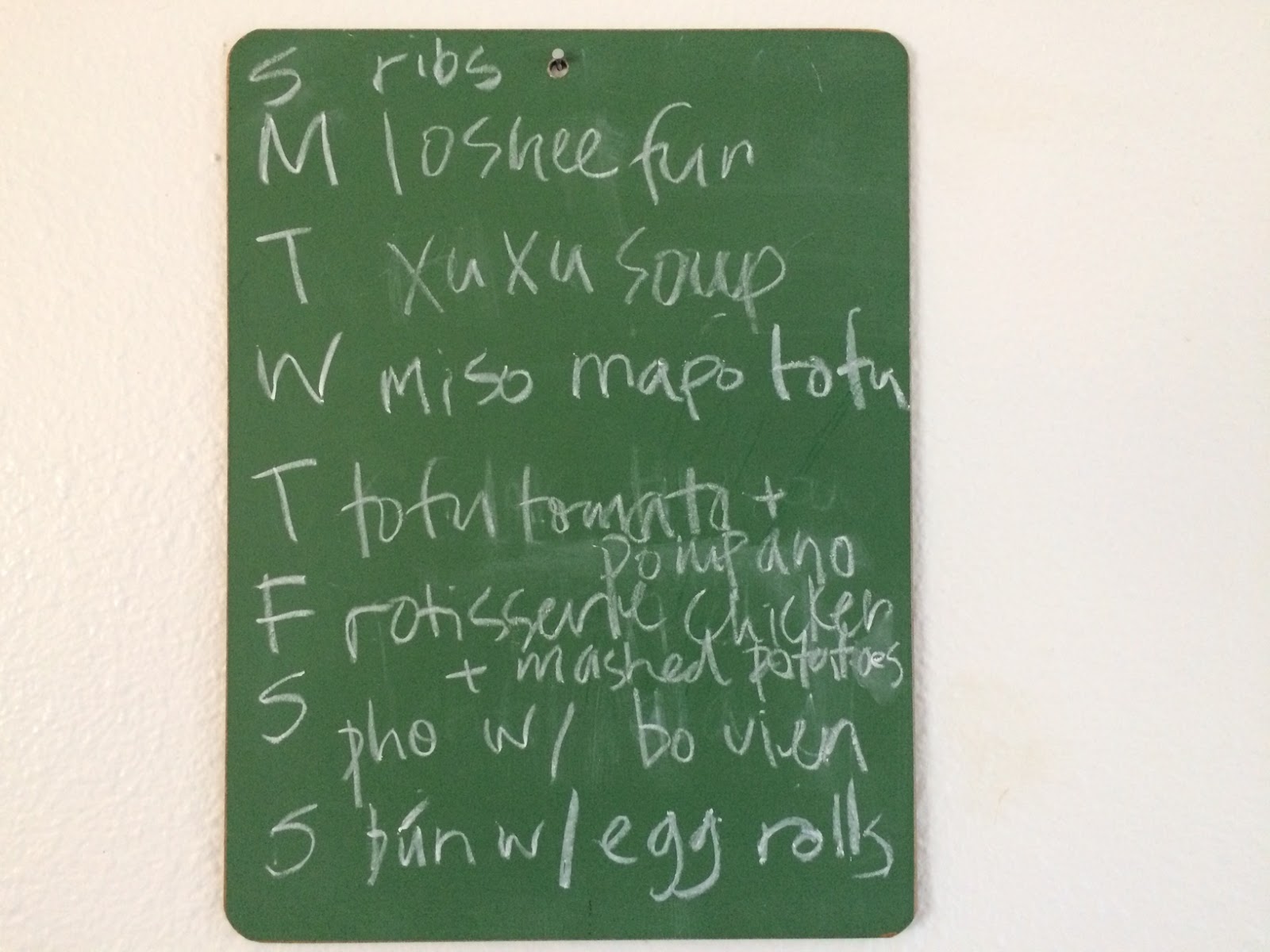

Miso mapo tofu is my own creation to make mapo tofu without gluten (so many black bean sauces have wheat in them, didn't know that before!). Miso works really well (not soy free, however) and makes a flavorful dish that incidentally serves as a non-spicy version great for kids! Another standby is to have rotisserie chicken from the grocery store on one night and make broth with the carcass the following day for pho (just add fish sauce!). For bĂșn (i.e., Viet noodle bowls), we work off of Molly's recipe from Delancey.

P.S. I am so giddy because apparently on February 23 I got my first two Amazon Affiliate purchases from this blog. Besides feeling giddy, I am so curious who that was, so if that was you and this wouldn't embarrass you, would you please let me know either by comment or email what you got?? Thanks, on all counts!

P.P.S. Shout-out to Christine, whose What I'm Reading series inspired this post, and which will inspire you as well.

9/21/2016

First-world hungry

first-world hungry = being hungry, but not for anything I have in my fridge

"Give me neither poverty nor riches. . .
Otherwise, I may have too much and disown you,
and say, 'Who is the Lord?'
Or I may become poor and steal,
and so dishonor the name of my God."
--Proverbs 30:8-9

David once mentioned to me that one of the signs of poverty in first-world countries is, perhaps unexpectedly, obesity.

While I don't want to get too much into social commentary here as I am not well studied on the topic, I do think it's a good launching point for the metaphor of the kind of stuff-obesity we fall prey to in our modern day first-world lives.

When we don't have enough quality in our lives, we may substitute quantity to make up for the feelings of poverty. It's easy to grab at every opportunity that comes our way when we're afraid of not getting opportunities in the future.

In an essay I wrote for my workshop group, I talked about how there was once a time not too long ago when, ironically, we couldn't afford to "declutter." 

I spent a lot of the first years of our marriage in a poverty mentality, even if it was just first-world poverty. (I'm careful here to say "I" because David is so much more above me.) I would ask David to cut the baby wipe packages in half and save pour-overs for the weekends because coffee filters cost $0.02 each.

Now that David's career is more stabilized I've felt free to let go of some things and in doing so I've had to confront a lot of my fears and the shame of having a scarcity mentality (c.f., once again, The Secret Sauce). 

***

I'm wrestling with the paradox that sometimes you need enough to get more. (This could probably be its own post one day.)

You need emotional resilience in order to grow. So when you're in a place of stuckness, how do you get momentum?

***

We once laughed at a pamphlet that came with some outdoor gear Kenny had purchased. In addition to instructions regarding the gear, the author of this little manual tried to provide the user with further instructions on survival, something I guess they thought might be relevant for the person who made the purchase. "Do not wait until you are without water to begin looking for water," it read. 

We guffawed*, but how often do we actually do this in life? And, to take this further, we could also say that the "opposite" of this is good advice, too: "Do not wait until you are drowning to begin asking for help." 

(*That was for you, Molly.)

I'm not drowning any more, though I have been there. Still, I'm realizing I need yet more margin. In particular, I'm seeing the value of having enough margin that I can make mistakes. If I want to live a brave and creative life, it will involve making mistakes.

(Molly {again}, fear not, I said "margin", not "margarine".)

***

On an unrelated train of thought...


Addenda, or Other Ramblings:

1. Wealth is the feeling of using or needing less than you are bringing in. I think we all know that living hand to mouth is no good, and that the "secret" to financial wealth is to spend less than you make (or, alternately, to make way more than you spend). But how often to we apply that to life? We want to fill our every moment with getting stuff done. What we if intentionally chose to spend less time than we have been granted? (Sabbath? We've been given seven days, and by choosing to not exhaust all seven days with work, we perhaps store up life-wealth.)

2. Another nugget I'm loving from Essentialism is the idea of shaping your life by design rather than be defaultMarie Kondo also talks about this when she mentions how it's easy to hold on to things we've been given (either as gifts or hand-me-downs) but that there are ways to let go of even those things, too, if you so desire. Similarly, with life opportunities, just like we should prioritize our own lives instead of letting others prioritize them for us, we should - for our own sake, and for the sake of making our greatest contribution to the world - think hard about designing our lives with intention - proactively, rather than reactively.

9/12/2016

Less, but better

"I'm going to donate these clothes I don't wear anymore to charity 
after I drive them around in the trunk of my car for eight months." 
--@amydillon

Sunk costs are one of the hardest things for me to let go of, and what made (and makes) KonMari so hard for me. 

Kenny, Whiz At Anything And Everything He Puts His Mind To, can often be found working on a computer that seems beyond repair, or trying to invent a solution to something that's never been done before. I love when, after many hours at something, he looks up from his project to tell us, "I've worked too hard for this not to work."

Kenny is perhaps the exception to the rule of sunk costs. But for the rest of us, while determination and contentment are good virtues, sometimes we just need to let it go.

Even now, if and when I find I'm not enjoying a book, I just stop. reading. it. (Gasp.) I'm not in school anymore (except for the School of Lisa), so who cares?

In EssentialismGreg McKeown provides a way to assess sunk costs from a different angle by having us ask, "If I did not have [fill-in-the-blank] already, how much would I pay to have it?" If the answer is zero, then you should probably get rid of it.

I think we sorely underestimate the weight of the "trivial many" (McKeown's term) that we keep in our lives. We think that these little things aren't that big of a deal, but they can add up to a larger cumulative effect, one that could even drive you insane.

But you wouldn't know it until you removed them all, ruthlessly and entirely.

This is why and how KonMari actually worked for me. When I first read the book, I didn't buy it (literally or figuratively). But many months later I picked it up and for some reason it was different. "When the student is ready, the teacher will appear."

I followed the prescription to start with clothes. I pulled out everything I had and asked myself if I loved the item (or if it "sparked joy"). Her method makes sense. When we get dressed in the morning, we don't dress "logically" - we don't wear the clothes we "think we ought to" wear, we wear the clothes that make us feel good. 

Because I'm a Questioner, I had to trick myself into the process. I didn't mentally commit to getting rid of the doesn't-spark-joy pile right away. But when I saw how happy I was with the remaining few, it was so much easier to clear away the "trivial many."

I applied this later to our silverware drawing by removing a few "blah" pieces. The simple joy of not having to dig past those anymore has increased my sanity by a seemingly disproportionate amount. 

Taking care of stuff is already hard. Taking care of stuff you dislike (or even feel neutral about) is tiresome.

Do you like your "darlings" enough to dilute that which you truly love? (I use the word "darlings" because the same thing applies to writing, which is why I've been loving how much writing is helping my brain flow. Combinatory play at work, once again.)

When I create margin in my life to have/do the things that are supremely important to me, I find that satisfaction and fulfillment so rich that I no longer care about the other things I once thought were important to me. In fact, I find how much I've actually medicated (!) with the "trivial many" because I've neglected the critical. 

I've been loving the journey I'm on because it's not decluttering for decluttering's sake, or because it's trendy to be a minimalist (that kind of thing does not appeal to a Questioner/Rebel) but because decluttering/curating my life has helped me celebrate my uniqueness, my quirks, and perhaps eventually, even my Purpose.